
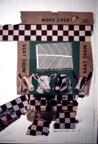
Goat Chow
Goat Chow, 1977
Robert Rauschenberg (American, 1925 – 2000)
#1980.0002.0007
Robert Rauschenberg began his artistic career at the Kansas City Art Institute and later at the Académie Julian in Paris. In 1948 Rauschenberg and his future wife, painter Susan Weil, moved to North Carolina to study at Black Mountain College under the artist Josef Albers. Later he continued his studies at the Art Students League of New York where he met artist Cy Twombly. Influenced by the work of Marcel Duchamp, Rauschenberg was interested in pursuing the distinction between art objects and everyday objects. In the 1960’s Rauschenberg began incorporating found objects into his works using the silkscreen process popularized by commercial applications but not, until that time, artistic practices. Contemporaneously with Andy Warhol and Jasper Johns these silk-screened works were considered precursors of the American Pop Art movement. In 1964 Rauschenberg became the first American artist to win the grand prize at the Venice Biennale, which provoked heated debate at the time.
The Chow Bag Series produced in 1977 incorporates many of the themes of Rauschenberg’s earlier works. The chow bag depicted was made by American company Purina Mills. This company was well known at the time for its innovative marketing strategy of offering prizes for collecting the box tops of Purina breakfast cereals. For Rauschenberg, this was American capitalism at its most innovative. Contrasting advertising with the traditional depiction of America as an agrarian nation (symbolized by the goat and pig), Rauschenberg alludes to the past and future role of America. Rauschenberg remained ambivalent about this role, further indicating both positive and negative connotations by incorporating images of chains, forms from nature, as well as other commercial brands and products.